
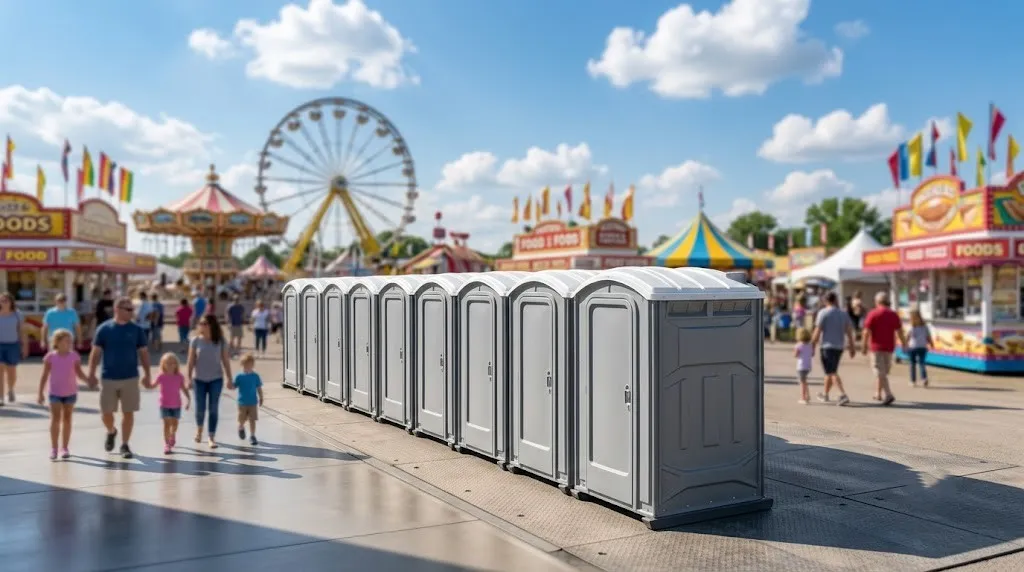
How many restrooms does a county fair need?
Start with your staff count, then layer in attendance. OSHA 1926.51(c) sets the baseline at 1 toilet facility for 20 workers or fewer, and 1 toilet seat plus 1 urinal per 40 workers once you pass that threshold. That rule covers your crew, judges and vendor staff, but fairgoers are a separate math problem entirely. A fair pulling a few thousand visitors over a weekend needs restrooms sized closer to festival-grade counts, not job-site counts, and our placement guide walks through both numbers side by side. Lenexa events tend to cluster restrooms near the midway, the grandstand and the food row, because walking distance drives usage more than total count does. ADA Standards section 213.2 requires that at least 5 percent of clustered single-user units be accessible, never fewer than one, so a bank of twenty standard units needs at least one ADA accessible porta potty in the mix. We also route handwash stations near every food vendor row, since fairgoers eating funnel cake with their hands care more about that than almost anything else on site. If you are not sure where to start, our guide on how many porta potties you need breaks it down by expected headcount and event length. For multi-day fairs we recommend standard porta potty rental as the backbone, with deluxe flushable units added near VIP or sponsor areas.
What does a county fair restroom package cost in Lenexa?
Pricing depends on unit type, how many days you need them, and whether you want an event rate or a straight weekly rate; our FAQ page covers common billing questions too. A single standard unit for a multi-day event runs in an event-rate band, while ADA units and handwash stations get quoted separately since usage patterns differ.
| unit | duration | typical price |
|---|---|---|
| standard | event | $400 |
| standard | weekend | $250 |
| ada | weekend | $240 |
| deluxe | week | $250 |
| delivery_fee | weekend | $200 |
A three-day county fair usually books under the weekend or event rate rather than a daily rate, since daily pricing adds up fast across three or four days of standing units. Delivery fees for weekend events run higher than weekday delivery because trucks are working around live crowds and tighter access windows. Full detail on how these bands are built lives on our cost breakdown page, and if your fair runs closer to a single day, per-day pricing may fit better than an event package. Fairs that repeat annually sometimes lock in monthly rental terms instead, especially if the fairgrounds also uses units for setup and teardown weeks. We also handle temporary fence rental for crowd lanes and vendor perimeters, sometimes with crowd control barriers at gate chokepoints, which often gets quoted alongside restrooms for the same event.
Where do restrooms get placed on fairgrounds?
Placement follows foot traffic, not the property line. ADA Standards section 403.5.1 requires a minimum 36 inch clear route to every accessible unit, and ADA Standards section 304.3.1 calls for a 60 inch turning circle in front of it, so we check ground stability under ADA Standards section 302.1 before we set anything on grass or gravel, a step covered in more depth in our OSHA requirements guide. A standard unit runs about 44 by 48 inches on the ground and stands roughly 92 inches tall, which matters when you are tucking units behind a barn or between vendor tents at a Lenexa fairground site. We stage clusters near entry gates, near the grandstand, and near the food row, then add a satellite cluster near livestock barns if animals are part of the event, similar to the layouts we use for farm and agricultural restrooms. Handwashing stations belong at every food and animal-contact point; 29 CFR 1910.141(d)(2) requires soap and towels or a hand-drying device at wash stations, and hand sanitizer alone does not meet that standard. If your fair includes petting zoos or agricultural exhibits, pair restroom clusters with handwashing station rental rather than sanitizer stands alone. For fairs pulling crowds from Merriam, roughly 9.9 miles northeast of Lenexa, or from Prairie Village, about 10.3 miles east, we factor drive time into delivery scheduling so units arrive set and serviced before gates open. Larger fairs sometimes add a restroom trailer near the grandstand for a nicer guest experience, and an 8 stall restroom trailer can absorb heavy line pressure during peak evening hours, with a 4 stall restroom trailer sized for smaller sponsor tents nearby.
How far in advance should we book restrooms for a county fair?
Book as soon as your dates are set, ideally 60 to 90 days out for a multi-day fair; see our rental checklist for what to line up first. Fair season books trucks fast across Lenexa and nearby towns, and ADA units sell out first since supply is thinner. Waiting until two weeks out limits your unit choices.
Do county fairs need ADA accessible units?
Yes. ADA Standards section 213.2 requires at least 5 percent of clustered portable units be accessible, never fewer than one. A large fair with several clusters needs an accessible unit at each cluster, not just one for the whole grounds.
Can we rent handwashing stations separately from restrooms?
Yes. Many fairs order handwash stations for food rows and livestock areas independent of the restroom count. Under 29 CFR 1910.141(d)(2), stations need soap and towels or a drying device, so we stock accordingly.
What is the difference between event rate and weekend rate?
Event rate covers extended multi-day fairs, usually three days or more, at a flat price per unit. Weekend rate fits a shorter two-day run. Ask our quote team which fits your fair's actual schedule, or start with our general contact page if you have questions first.
Do you service units during a multi-day fair?
Yes. Multi-day fairs get a mid-run service pass, not just delivery and pickup. High-traffic clusters near food and grandstands often need it, and we schedule that before booking closes.
Next step
Get a delivery date
Tell us the address, the dates and the headcount. We size the order and confirm the route.